Eddie Murphy at his best !
It’s an amazing world we live in.
Eddie Murphy at his best !
People are often unreasonable, illogical and self centered; Forgive them anyway.
If you are kind, people may accuse you of selfish, ulterior motives; Be kind anyway.
If you are successful, you will win some false friends and some true enemies; Succeed anyway.
If you are honest and frank, people may cheat you; Be honest and frank anyway.
What you spend years building, someone could destroy overnight; Build anyway.
If you find serenity and happiness, they may be jealous; Be happy anyway.
The good you do today, people will often forget tomorrow; Do good anyway.
Give the world the best you have, and it may never be enough; Give the world the best you’ve got anyway.
You see, in the final analysis, it is between you and God; It was never between you and them anyway.
These glorious insults are from an era before the English language changed to 4-letter words.
A member of Parliament to Disraeli: “Sir, you will either die on the gallows or of some unspeakable disease.”
“That depends, Sir,” said Disraeli, “whether I embrace your policies or your mistress.”
“He had delusions of adequacy.” – Walter Kerr
“He has all the virtues I dislike and none of the vices I admire. – Winston Churchill
“I have never killed a man, but I have read many obituaries with great pleasure.” – Clarence Darrow
“He has never been known to use a word that might send a reader to the dictionary.” – William Faulkner (about Ernest Hemingway)
“Thank you for sending me a copy of your book; I’ll waste no time reading it.” – Moses Hadas
“I didn’t attend the funeral, but I sent a nice letter saying I approved of it.” – Mark Twain
“He has no enemies, but is intensely disliked by his friends.” – Oscar Wilde
“I feel so miserable without you; it’s almost like having you here.” – Stephen Bishop
“He is a self-made man and worships his creator.” – John Bright
I’ve just learned about his illness. Let’s hope it’s nothing trivial.” – Irvin S. Cobb
“He is not only dull himself; he is the cause of dullness in others.” – Samuel Johnson
“He is simply a shiver looking for a spine to run up.” – Paul Keating
“In order to avoid being called a flirt, she always yielded easily.” – Charles, Count Talleyrand
“He loves nature in spite of what it did to him.” – Forrest Tucker
“Why do you sit there looking like an envelope without any address on it?” – Mark Twain
“His mother should have thrown him away and kept the stork.” – Mae West
“Some cause happiness wherever they go; others, whenever they go.” – Oscar Wilde
“He uses statistics as a drunken man uses lamp-posts … for support rather than illumination.” – Andrew Lang
“He has Van Gogh’s ear for music.” – Billy Wilder
“I’ve had a perfectly wonderful evening. But this wasn’t it.” – Groucho Marx


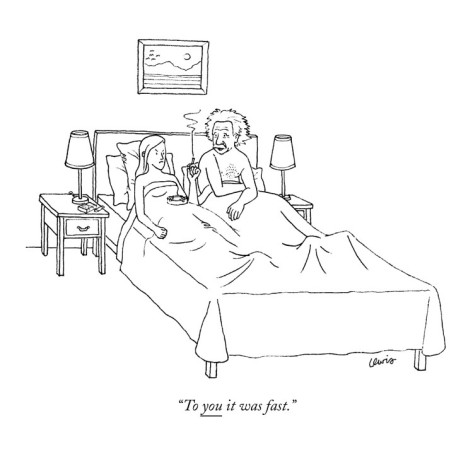
Einstein in bed …
An atheist was seated next to a little girl on an airplane and he turned to her and said, “Do you want to talk? Flights go quicker if you strike up a conversation with your fellow passenger.” The little girl, who had just started to read her book, replied to the total stranger, “What would you want to talk about?” “Oh, I don’t know,” said the atheist. “How about why there is no God, or no Heaven or Hell, or no life after death?” as he smiled smugly. “Okay,” she said. “Those could be interesting topics but let me ask you a question first. A horse, a cow, and a deer all eat the same stuff – grass. Yet a deer excretes little pellets, while a cow turns out a flat patty, but a horse produces clumps. Why do you suppose that is?” The atheist, visibly surprised by the little girl’s intelligence, thinks about it and says, “Hmmm, I have no idea.” To which the little girl replies, “Do you really feel qualified to discuss God, Heaven and Hell, or life after death, when you don’t know s-h-i-t?”
 PrettyApt