A government which robs Peter to pay Paul can always depend on the support of Paul. – George Bernard Shaw
Category Archives: Bottled at source
The best things in life come from source.
The Carpenter
An elderly carpenter was ready to retire. He told his employer-contractor of his plans to leave the house-building business and live a more leisurely life with his wife enjoying his extended family.
He would miss the pay cheque, but he needed to retire. They could get by.
The contractor was sorry to see his good worker go and asked if he could build just one more house as a personal favour. The carpenter said yes, but in time it was easy to see that his heart was not in his work. He resorted to shoddy workmanship and used inferior materials. It was an unfortunate way to end a dedicated career.
When the carpenter finished his work the employer came to inspect the house. He handed the front-door key to the carpenter, he said, “my gift to you”. The carpenter was shocked! What a shame! If he had only known he was building his own house, he would have done it all so differently.
So it is with us. We build our lives, a day at a time, often putting less than our best into the building. Then with a shock we realise we have to live in the house we have built. If we could do it over we’d do it much differently. But we cannot go back.
You are the carpenter. Each day you hammer a nail, place a board, or erect a wall.
“Life is a do-it-yourself project, “someone has said : Your attitudes and the choices you make today, build the “house” you live in tomorrow.
Build wisely! Work as if you don’t need the money. Learn as if you will live forever. Love as if you’ve never been hurt. Dance as if nobody is watching.
TGIF
Violinist in the Metro
A man sat at a metro station in Washington DC and started to play the violin; it was a cold January morning. He played six Bach pieces for about 45 minutes. During that time, since it was rush hour, it was calculated that thousands of people went through the station, most of them on their way to work. Three minutes went by and a middle aged man noticed there was musician playing. He slowed his pace and stopped for a few seconds and then hurried up to meet his schedule. A minute later, the violinist received his first dollar tip: a woman threw the money in the till and without stopping continued to walk. A few minutes later, someone leaned against the wall to listen to him, but the man looked at his watch and started to walk again. Clearly he was late for work. The one who paid the most attention was a 3 year old boy. His mother tagged him along, hurried but the kid stopped to look at the violinist. Finally the mother pushed hard and the child continued to walk turning his head all the time. This action was repeated by several other children. All the parents, without exception, forced them to move on.
In the 45 minutes the musician played, only 6 people stopped and stayed for a while. About 20 gave him money but continued to walk their normal pace. He collected $32. When he finished playing and silence took over, no one noticed it. No one applauded, nor was there any recognition.
No one knew this but the violinist was Joshua Bell, one of the best musicians in the world. He played one of the most intricate pieces ever written with a violin worth 3.5 million dollars.
Two days before his playing in the subway, Joshua Bell sold out at a theater in Boston and the seats average $100.
This is a real story. Joshua Bell playing incognito in the metro station was organized by the Washington Post as part of an social experiment about perception, taste and priorities of people. The outlines were: in a commonplace environment at an inappropriate hour: Do we perceive beauty? Do we stop to appreciate it? Do we recognize the talent in an unexpected context?
One of the possible conclusions from this experience could be: If we do not have a moment to stop and listen to one of the best musicians in the world playing the best music ever written, how many other things are we missing?
Dave is extraordinary !
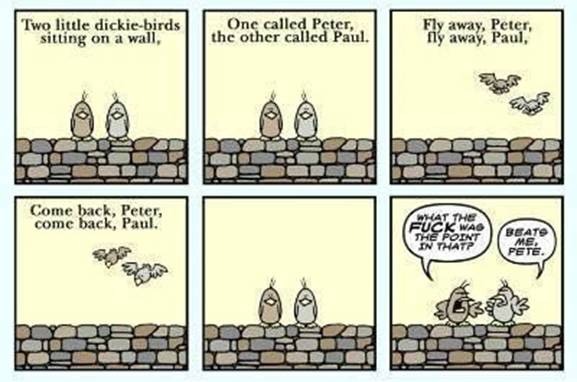
Peter and Paul
Mobile movies
the Dollar Shave Club keeps at it
Love
Not all of us can do great things. But we can do small things with great love. – Mother Teresa
Leadership
Leadership is a combination of strategy and character. If you must be without one, be without the strategy. – Norman Schwarzkopf
 PrettyApt