Category Archives: Bottled at source
The best things in life come from source.
Falling In Love
“From Curiosity to Attention. From Attention to Amazement. From Amazement to Admiration. From Admiration to Love.”
http://billabbottmagic.blogspot.ca/2013/05/falling-in-love.html
The source is all about hard work
Hard work without talent is a shame, but talent without hard work is a tragedy. – Robert Half
Some people spend time to save money, others spend money to save time
Time is more valuable than anything. I know, I am stating the obvious but when it comes to time I am becoming more and more selective about where I spend it.
I have invested a lot of time and resources into various computer projects and movie ventures this past year. And I am always intrigued when I hear film makers talk about the risks they’re taking. Let’s see, I work from sunrise to sunset, and more, 7 days a week, and I invest money and then, I keep hearing about the risk that everyone is taking. What risk? Go tell a bank about the risk you’re taking when you put in babkas … yeah right.
Now I am not trying to trivialize anyone’s role or contribution, but I do battle to understand how a 21-year-old university graduate can say that they are taking a risk by making a film. If the film doesn’t work (which is the case most of the time) then I lose some money and life goes on. What risk did the film maker take? I, on the other hand, I am not straight out of university, and I have opportunities thrown at me each week. When we embark on a new project that means I have to turn other opportunities away. There is a cost to this. But, I am often told how we are all sharing the risk. It almost sounds like we are all in it together as equal partners. Split the financial investment with me; then we will be real partners.
Let’s assume for this discussion that we have indeed split the costs. Let’s assume that we have all made a financial investment. Yes, then we are all at risk. But in terms of the time factor, how does one put a value on the time they have invested? One simple answer could be that if you are offered a job opportunity that pays, say, a million dollars a year, and you turn it down, then your cost for that year could be said to be a million dollars. But if you were unemployed, straight out of university, and you spend a year on a new project, then what opportunity costs have you foregone?
My conclusion is that it is most often very difficult for people to understand the true costs of doing business. People in different situations with different track records cannot value their time the same. Yes, an hour of my day is the same as an hour of your day. But, if I had the potential to earn, say, a million dollars an hour, and I took an hour off, then that million dollars would have to be considered. And, if another person was earning say, 100 dollars an hour, and they took an hour off, then the financial component here is quite different. And this is the point I am trying to make. Yes, I know this requires a great deal of sensitivity as people get very defensive when you imply that someone’s time may be less valuable than yours, but this is a very real consideration. The value of human capital is not an easy thing to understand and we all tend to sell ourselves short.
I once heard a saying which said that some people spend time to save money while others spend money to save time. I have been very fortunate in my life to have been financially independent from a young age. I always look to spend money to save time because I really battle to find the time to process all the opportunities that exist around me.
I have people telling me every other week about how they don’t like to have their time wasted and yet it is often these same people who will then go and get stuck in traffic for hours going to pick up their dry cleaning. This makes no sense to me. I would rather pay someone to collect my dry cleaning because that time that I save is more valuable to me. But, I guess one needs to understand the value of their own human capital or potential and then one would not be so quick to voluntarily get stuck in traffic.
Now consider those who travel business class. I do sometimes, but not too often. I would rather give the money to those who need it. Business class, like many other privileges, is not about saving time. We all arrive at our destination together, at the same time. Business class is about comfort and status. It is about luxury and relaxation. It is also intriguing to me that so often the same people who allow themselves to get stuck in traffic for hours also put up a big fuss when it comes to air travel (but this is a whole other story).
Today’s piece was just something I often battle to put in words. I hope I have sparked some food for thought. As someone who is trying to lead people, I often have to challenge people’s thoughts and ideas. Yes, time is indeed the most valuable thing we have, and when people are aligned it certainly saves a lot of hours.
Content could be king …
If you want to make a movie, then all you need is money. Talent helps too. And if you want to lose money, then all you need to do is make the movie … talent won’t matter here. Yes, there is a 95% chance you will lose all the money. And that’s the arts business for you. Content is hit and miss. Very few winners. Lots and lots of losers.
Luck and the source
Leading people is most often not a popularity contest. It sounds exciting and fun, but it really is hard work. It can be very rewarding and it certainly can be fulfilling, but it is often filled with disappointments and struggle.
Building a business and nurturing and growing people is like raising kids. You get out what you put in. Well, that is the theory anyway. But, there are risks with both of these.
Most businesses don’t go on to make magic in the world and most start-ups fail. You go about building your business, putting in so much, to try to find some joy in the world but so often you land up with stress, disappointment and pain. It is the same with raising kids. Sure, you hope that your kids will bring you joy later in life, but often, kids can also bring you anxiety, hardship and pain.
If you look at the problem children out there, you never really have to look further than the source. The same with a failing business. When no one really cares, this is what happens. In short, there is a risk in trying to build a company and in raising kids – you want to find magic but you often find only struggle.
On the other hand, you can give it all you got, and work hard, and still, there is no guarantee that your kids will turn out good. Like there is no guarantee a business will work, even if you do everything right. Luck always plays a role. You could raise your kids great, and they could still turn out to be lemons. And you could lead people in a business, with an inspired soul, and work harder than anyone, and set an example, and still go nowhere.
Leadership requires an element of luck. I am more and more convinced of this.
Internet Solutions is 20 years old soon … wow !
Nothing for Mahala
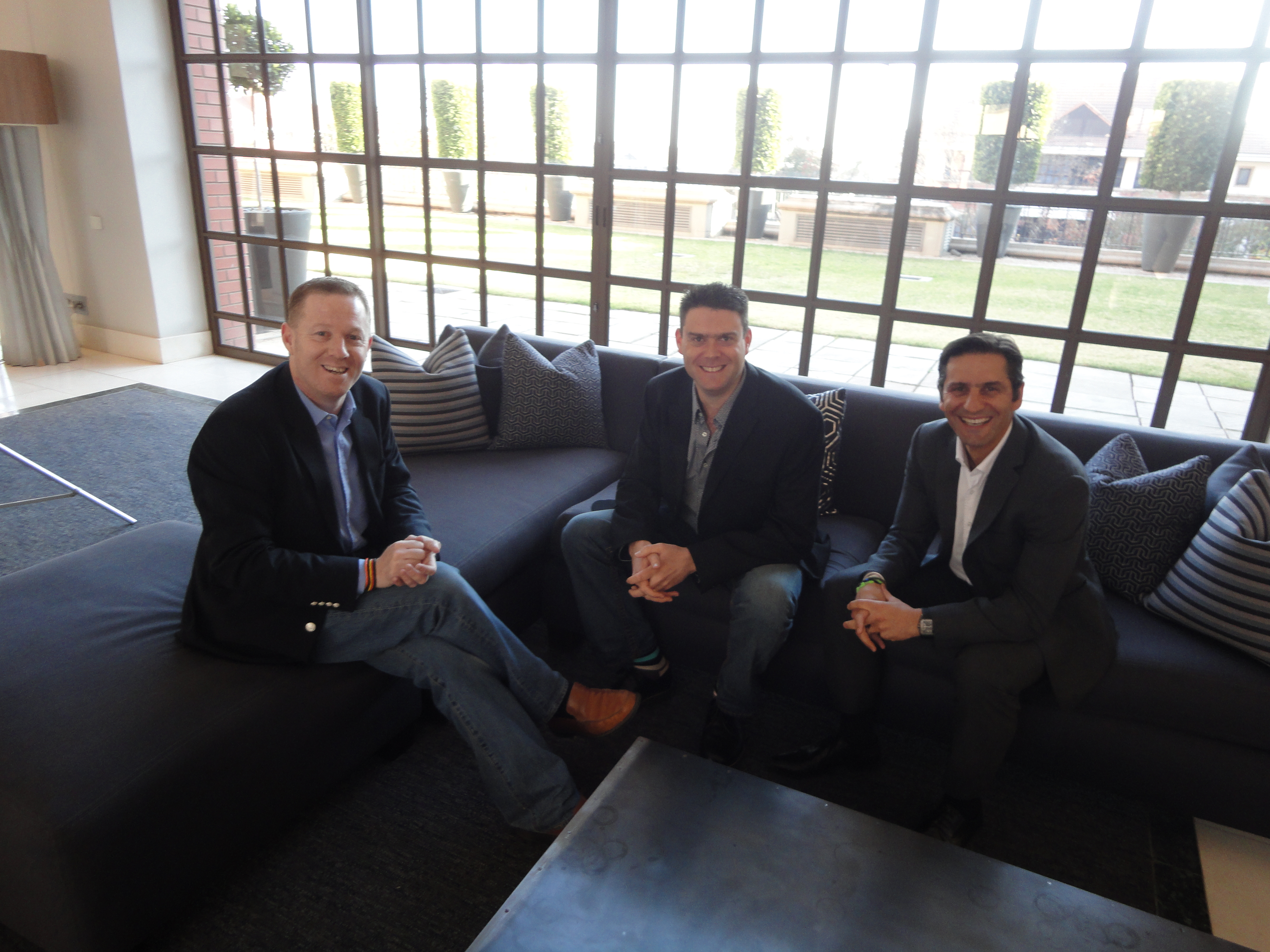
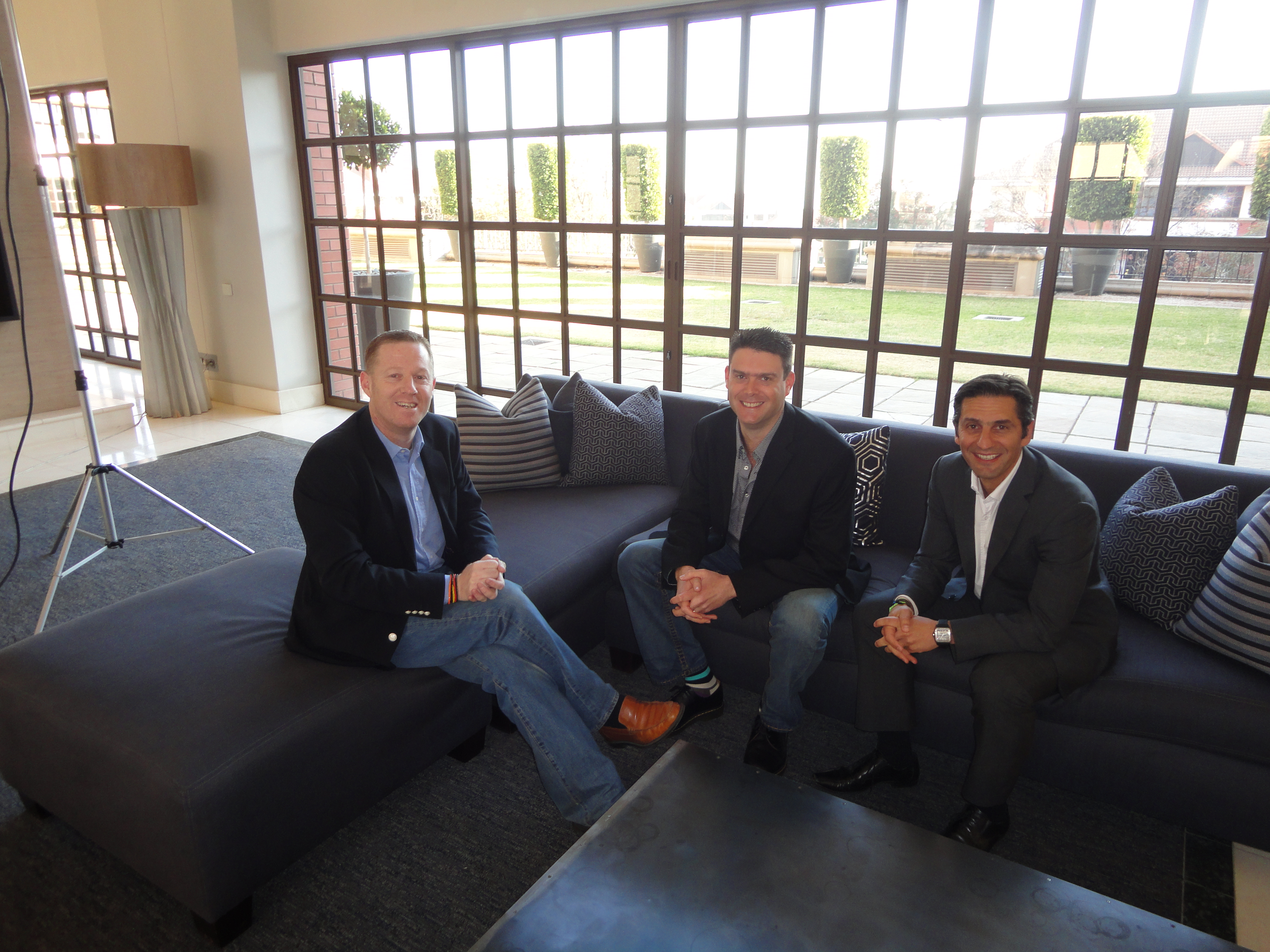
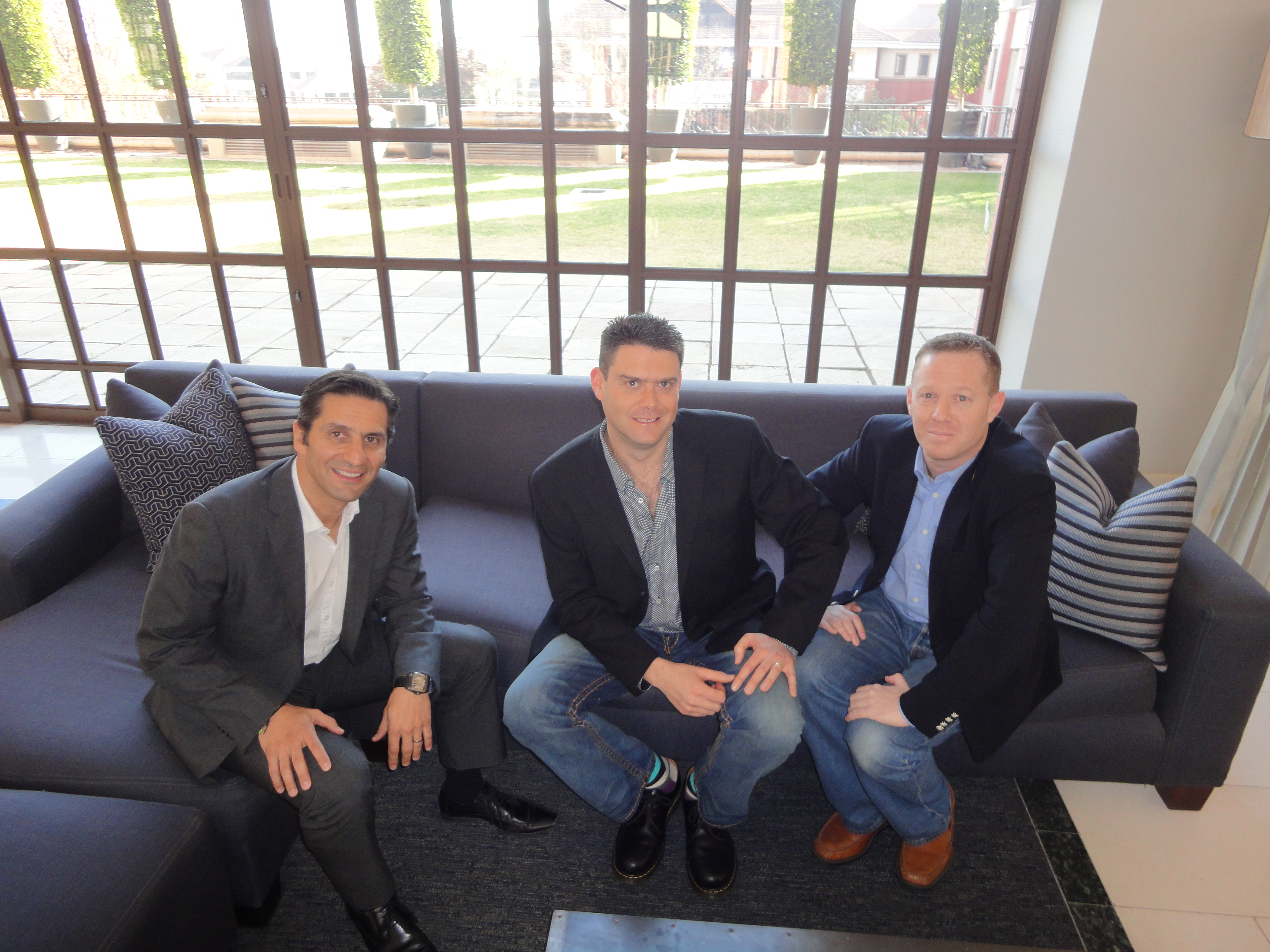
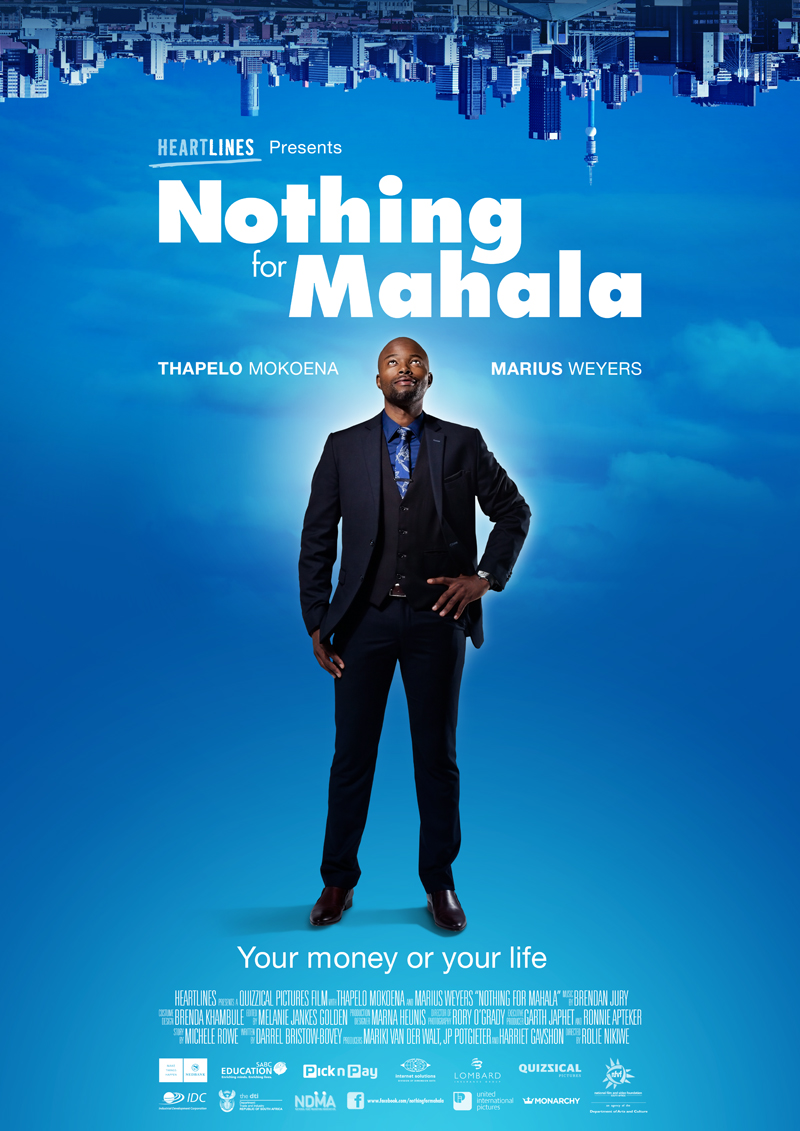
The Heartlines film “Nothing for Mahala” comes out in 3 months … we got our first poster signed off today.
Love is a verb
If you really love your product or service then it is easy to get excited about it when you share it with others. If you believe in what you do then you are not really selling when you tell others about it; you are just sharing something you believe in, something that excites you, something you are passionate about.
Conversely, when you don’t care about what you are selling then real selling needs to take place. And then again, some salesmen are good at just selling, anything. And of course, some of the greatest salesmen are not really salesmen, they are just expressing what they love and like and it rubs off on those who believe in them.
It is only a hustle if you don’t believe in what you are selling.
Yes, there is always a struggle, and yes, it gets intense, for sure, but if you belive in what you are selling then it is no hustle. When you inspire people it is never a hustle. When it comes from source then it is labour of love.
So, who of us are salesmen, or saleswomen? I think the answer is all of us. We are all in sales. Every time we try to convince someone of something we are selling. There are no rules when it comes to selling but there is some universal wisdom. Listen, love what you do, and be honest. Of course, many salesmen don’t listen, and are not honest. As for loving what they do, well, that is something a lot of people simply don’t think about. For most people it is really all about paying the rent and one has to respect that. There is no right or wrong here. There are just different ways of seeing the world.
Right now, on our journey with “Nothing for Mahala” we are loving what we do, and we are sharing our dream with whoever we come in contact with. If you inspired by this work, then support us, and spread the word! If you do that then we have made a sale.
Dan Ariely asks, Are we in control of our own decisions?
www.ted.com/talks/dan_ariely_asks_are_we_in_control_of_our_own_decisions.html#
Transcript :
I’ll tell you a little bit about irrational behavior. Not yours, of course. Other people’s.
(Laughter)
So after being at MIT for a few years, I realized that writing academic papers is not that exciting. You know, I don’t know how many of those you read. But it’s not fun to read and often not fun to write. Even worse to write. So I decided to try and write something more fun. And I came up with an idea that I will write a cookbook. And the title for my cookbook was going to be “Dining Without Crumbs: The Art of Eating Over the Sink.” (Laughter) And it was going to be a look at life through the kitchen. And I was quite excited about this. I was going to talk a little bit about research, a little bit about the kitchen. You know, we do so much in the kitchen I thought this would be interesting. And I wrote a couple of chapters. And I took it to MIT press and they said, “Cute. But not for us. Go and find somebody else.” I tried other people and everybody said the same thing, “Cute. Not for us.”
Until somebody said, “Look, if you’re serious about this, you first have to write a book about your research. You have to publish something. And then you’ll get the opportunity to write something else. If you really want to do it you have to do it.” So I said, “You know, I really don’t want to write about my research. I do this all day long. I want to write something else. Something a bit more free, less constrained.” And this person was very forceful and said, “Look. That’s the only way you’ll ever do it.” So I said, “Okay, if I have to do it — ” I had a sabbatical. I said, “I’ll write about my research if there is no other way. And then I’ll get to do my cookbook.” So I wrote a book on my research.
And it turned out to be quite fun. In two ways. First of all I enjoyed writing. But the more interesting thing was that I started learning from people. It’s a fantastic time to write. Because there is so much feedback you can get from people. People write me about their personal experience, and about their examples, and what they disagree, and nuances. And even being here. I mean the last few days, I’ve known really heights of obsessive behavior I never thought about. (Laughter) Which I think is just fascinating.
I will tell you a little bit about irrational behavior. And I want to start by giving you some examples of visual illusion as a metaphor for rationality. So think about these two tables. And you must have seen this illusion. If I asked you what’s longer, the vertical line on the table on the left, or the horizontal line on the table on the right? Which one seems longer? Can anybody see anything but the left one being longer? No, right? It’s impossible. But the nice thing about visual illusion is we can easily demonstrate mistakes. So I can put some lines on. It doesn’t help. I can animate the lines. And to the extent you believe I didn’t shrink the lines, which I didn’t, I’ve proven to you that your eyes were deceiving you. Now, the interesting thing about this is when I take the lines away, it’s as if you haven’t learned anything in the last minute. (Laughter) You can’t look at this and say, “Okay now I see reality as it is.” Right? It’s impossible to overcome this sense that this is indeed longer. Our intuition is really fooling us in a repeatable, predictable, consistent way. And there is almost nothing we can do about it. Aside from taking a ruler and starting to measure it.
Here is another one. This is one of my favorite illusions. What do you see the color that top arrow is pointing to? Brown. Thank you. The bottom one? Yellow. Turns out they’re identical. Can anybody see them as identical? Very very hard. I can cover the rest of the cube up. and if I cover the rest of the cube you can see that they are identical. And if you don’t believe me you can get the slide later and do some arts and crafts and see that they’re identical. But again it’s the same story that if we take the background away, the illusion comes back. Right. There is no way for us not to see this illusion. I guess maybe if you’re colorblind I don’t think you can see that. I want you to think about illusion as a metaphor.
Vision is one of the best things we do. We have a huge part of our brain dedicated to vision. Bigger than dedicated to anything else. We do more vision more hours of the day than we do anything else. And we are evolutionarily designed to do vision. And if we have these predictable repeatable mistakes in vision, which we’re so good at, what’s the chance that we don’t make even more mistakes in something we’re not as good at. For example, financial decision making. (Laughter) Something we don’t have an evolutionary reason to do. We don’t have a specialized part of the brain, and we don’t do that many hours of the day. And the argument is in those cases it might be the issue that we actually make many more mistakes. And worse, not have an easy way to see them. Because in visual illusions we can easily demonstrate the mistakes. In cognitive illusion it’s much, much harder to demonstrate to people the mistakes.
So I want to show you some cognitive illusions, or decision making illusions, in the same way. And this is one of my favorite plots in social sciences. It’s from a paper by Johnson and Goldstein. And it basically shows the percentage of people who indicated they would be interested in giving their organs to donation. And these are different countries in Europe. And you basically see two types of countries. Countries on the right that seem to be giving a lot. And countries on the left that seem to giving very little, or much less. The question is, Why? Why do some countries give a lot and some countries give a little?
When you ask people this question, they usually think that it has to be something about culture. Right? How much do you care about people? Giving your organs to somebody else is probably about how much you care about society, how linked you are. Or maybe it is about religion. But if you look at this plot you can see that countries that we think about as very similar actually exhibit very different behavior. For example, Sweden is all the way on the right. And Denmark that we think is culturally very similar is all the way on the left. Germany is on the left. And Austria is on the right. The Netherlands is on the left. And Belgium is on the right. And finally, depending on your particular version of European similarity, you can think about the U.K and France as either similar culturally or not. But it turns out that from organ donation they are very different.
By the way, the Netherlands is an interesting story. You see the Netherlands is kind of the biggest of the small group. Turns out that they got to 28 percent after mailing every household in the country a letter begging people to join this organ donation program. You know the expression, “Begging only gets you so far.” It’s 28 percent in organ donation.
(Laughter)
But whatever the countries on the right are doing they are doing a much better job than begging. So what are they doing? Turns out the secret has to do with a form at the DMV. And here is the story. The countries on the left have form at the DMV that looks something like this. Check the box below if you want to participate in the organ donor program. And what happens? People don’t check. And they don’t join. The countries on the right, the ones that give a lot, have a slightly different form. It says check the box below if you don’t want to participate. Interestingly enough, when people get this, they again don’t check. But now they join.
(Laughter)
Now think about what this means. We wake up in the morning and we feel we make decisions. We wake up in the morning and we open the closet. And we feel that we decide what to wear. And we open the refrigerator. And we feel that we decide what to eat. What this is actually saying is that much of these decisions are not residing within us. They are residing in the person who is designing that form. When you walk into the DMV, the person who designed the form will have a huge influence on what you’ll end up doing. Now it’s also very hard to intuit these results. Think about it for yourself. How many of you believe that if you went to renew your license tomorrow, and you went to the DMV, and you would encounter one of these forms, that it would actually change your own behavior? Very, very hard to think that you will influence us. We can say, “Oh, these funny Europeans. Of course it would influence them.” But when it comes to us we have such a feeling that we are at the drivers seat, we have such a feeling that we are in control, and we are making the decision, that it’s very hard to even accept the idea that we actually have an illusion of making a decision, rather than an actual decision.
Now, you might say, “These are decisions we don’t care about.” In fact, by definition, these are decisions about something that will happen to us after we die. How could we care about something less than something that happens after we die? So a standard economist, someone who believes in rationality, would say, “You know what? The cost of lifting the pencil and marking a V is higher than the possible benefit of the decision.” So that’s why we get this effect. But, in fact, it’s not because it’s easy. It’s not because it’s trivial. It’s not because we don’t care. It’s the opposite. It’s because we care. It’s difficult and it’s complex. And it’s so complex that we don’t know what to do. And because we have no idea what to do we just pick whatever it was that was chosen for us.
I’ll give you one more example for this. This is from a paper by Redelmeier and Schaefer. And they said, “Well, this effect also happens to experts, people who are well paid, experts in their decisions, do it a lot.” And they basically took a group of physicians. And they presented to them a case study of a patient. Here is a patient. He is a 67 year old farmer. He’s been suffering from a right hip pain for a while. And then they said to the physician, “You decided a few weeks ago that nothing is working for this patient. All these medications. Nothing seems to be working. So you refer the patient to hip replacement therapy. Hip replacement. Okay?” So the patient is on a path to have his hip replaced. And then they said to half the physicians, they said, “Yesterday you reviewed the patient’s case and you realized that you forgot to try one medication. You did not try ibuprofen. What do you do? Do you pull the patient back and try ibuprofen? Or do you let them go and have hip replacement?” Well the good news is that most physicians in this case decided to pull the patient and try the ibuprofen. Very good for the physicians.
The other group of the physicians, they said, “Yesterday when you reviewed the case you discovered there were two medications you didn’t try out yet, ibuprofen and piroxicam.” And they said, “You have two medications you didn’t try out yet. What do you do? You let them go. Or you pull them back. And if you pull them back do you try ibuprofen or piroxicam? Which one?” Now think of it. This decision makes it as easy to let the patient continue with hip replacement. But pulling them back, all of the sudden becomes more complex. There is one more decision. What happens now? Majority of the physicians now choose to let the patient go to hip replacement. I hope this worries you, by the way — (Laughter) when you go to see your physician. The thing is is that no physician would ever say, “Piroxicam, ibuprofen, hip replacement. Let’s go for hip replacement.” But the moment you set this as the default it has a huge power over whatever people end up doing.
I’ll give you a couple of more examples on irrational decision making. Imagine I give you a choice. Do you want to go for a weekend to Rome? All expenses paid, hotel, transportation, food, breakfast, a continental breakfast, everything. Or a weekend in Paris? Now, a weekend in Paris, a weekend in Rome, these are different things. They have different food, different culture, different art. Now imagine I added a choice to the set that nobody wanted. Imagine I said, “A weekend in Rome, a weekend in Paris, or having your car stolen?” (Laughter) It’s a funny idea. Because why would having your car stolen, in this set, influence anything? (Laughter) But what if the option to have your car stolen was not exactly like this. What if it was a trip to Rome, all expenses paid, transportation, breakfast. But doesn’t include coffee in the morning. If you want coffee you have to pay for it yourself. It’s two euros 50. Now in some ways, given that you can have Rome with coffee, why would you possibly want Rome without coffee? It’s like having your car stolen. It’s an inferior option. But guess what happened. The moment you add Rome without coffee, Rome with coffee becomes more popular. And people choose it. The fact that you have Rome without coffee makes Rome with coffee look superior. And not just to Rome without coffee, even superior to Paris.
(Laughter)
Here are two examples of this principle. This was an ad from The Economist a few years ago that gave us three choices. An online subscription for 59 dollars. A print subscription for 125. Or you could get both for 125. (Laughter) Now I looked at this and I called up The Economist. And I tried to figure out what were they thinking. And they passed me from one person to another to another. Until eventually I got to a person who was in charge of the website. And I called them up. And they went to check what was going on. The next thing I know, the ad is gone. And no explanation.
So I decided to do the experiment that I would have loved The Economist to do with me. I took this and I gave it to 100 MIT students. I said, “What would you choose?” These are the market share. Most people wanted the combo deal. Thankfully nobody wanted the dominated option. That means our students can read. (Laughter) But now if you have an option that nobody wants you can take it off. Right? So I printed another version of this. Where I eliminated the middle option. I gave it to another 100 students. Here is what happens. Now the most popular option became the least popular. And the least popular became the most popular.
What was happening was the option that was useless, in the middle, was useless in the sense that nobody wanted it. But it wasn’t useless in the sense that it helped people figure out what they wanted. In fact, relative to the option in the middle, which was get only the print for 125, the print and web for 125 looked like a fantastic deal. And as a consequence, people chose it. The general idea here, by the way, is that we actually don’t know our preferences that well. And because we don’t know our preferences that well we’re susceptible to all of these influences from the external forces. The defaults, the particular options that are presented to us. And so on.
One more example of this. People believe that when we deal with physical attraction, we see somebody, and we know immediately whether we like them or not. Attracted or not. Which is why we have these four-minute dates. So I decided to do this experiment with people. I’ll show you graphic images of people — not real people. The experiment was with people. I showed some people a picture of Tom, and a picture of Jerry. I said “Who do you want to date? Tom or Jerry?” But for half the people I added an ugly version of Jerry. I took Photoshop and I made Jerry slightly less attractive. (Laughter) The other people, I added an ugly version of Tom. And the question was, will ugly Jerry and ugly Tom help their respective, more attractive brothers? The answer was absolutely yes. When ugly Jerry was around, Jerry was popular. When ugly Tom was around, Tom was popular.
(Laughter)
This of course has two very clear implications for life in general. If you ever go bar hopping who do you want to take with you?
(Laughter) You want a slightly uglier version of yourself. (Laughter) Similar. Similar … but slightly uglier. (Laughter) The second point, or course, is that if somebody else invites you, you know how they think about you. (Laughter) Now you’re getting it.
What is the general point? The general point is that when we think about economics we have this beautiful view of human nature. “What a piece of work is man! How noble in reason!” We have this view of ourselves, of others. The behavioral economics perspective is slightly less generous to people. In fact in medical terms, that’s our view. (Laughter) But there is a silver lining. The silver lining is, I think, kind of the reason that behavioral economics is interesting and exciting. Are we Superman? Or are we Homer Simpson?
When it comes to building the physical world, we kind of understand our limitations. We build steps. And we build these things that not everybody can use obviously. (Laughter) We understand our limitations. And we build around it. But for some reason when it comes to the mental world, when we design things like healthcare and retirement and stockmarkets, we somehow forget the idea that we are limited. I think that if we understood our cognitive limitations in the same way that we understand our physical limitations, even though they don’t stare us in the face in the same way, we could design a better world. And that, I think, is the hope of this thing.
Thank you very much.
 PrettyApt